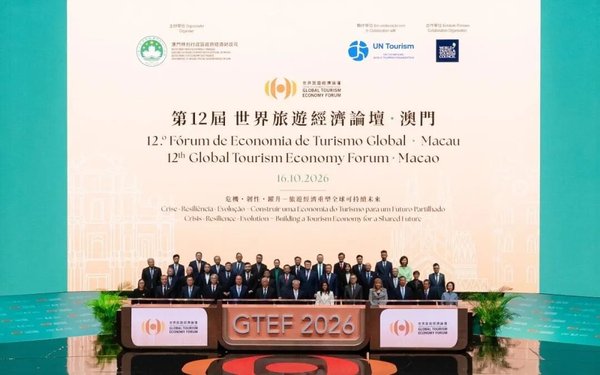

"The 12th World Tourism Economy Forum ・ Macau" Held | Pansy Ho Gives Closing Remarks
According to the Macau Special Administrative Region Government Tourism Office: 'The 12th World Tourism Economy Forum - Macau' was held here on the 16th. This edition of the forum, themed 'Crisis·Resilience·Leap – Tourism Economy Reshaping a Global Sustainable Future,' brought together representatives from the tourism industry and related sectors from around the world to discuss new trends, opportunities, and challenges in global tourism economic development.
He Houhua, Vice Chairman of the National Committee of the Chinese People's Political Consultative Conference and President of the World Tourism Economy Forum, Macau SAR Chief Executive Ho Iat Seng, Director of the Macau Liaison Office Zheng Xincai, Acting Commissioner of the Ministry of Foreign Affairs Macau Office Cheng Lei, Hainan Provincial Standing Committee member and Executive Vice Governor Ba Ter, UN World Tourism Organization Secretary-General Shaikha Al Nouwais, European Tourism Council Chairman and Director of Spain National Tourism Administration Miguel Sanz, World Tourism Alliance Chairman Zhang Xu, China Tourism Association Secretary-General Ge Lei, and other guests attended the opening ceremony.
In his speech, He Houhua noted that tourism is not only an engine for economic growth but also a crucial avenue for achieving sustainable development goals, building global consensus, and promoting mutual understanding among civilizations. Standing at this new historical starting point, the forum is expected to meet the nation's expectations, use Macau as a hub to gather the strength of tourism professionals worldwide, and make new and greater contributions to sustainable global tourism development.
Speech by He Houhua, Vice Chairman of the National Committee of the Chinese People's Political Consultative Conference and President of the World Tourism Economy Forum
Ho Iat Seng said that last year, visitor numbers to Macau exceeded 40 million, hitting a historic record. The new 'tourism+' business formats are showing strong vitality, and international and diversified development is accelerating. He hopes that the forum will gather global wisdom and create cooperation, providing support for Macau's own development while injecting new momentum into the high-quality development of the global tourism economy, moving together toward a more resilient and sustainable future.
Speech by Ho Iat Seng, Chief Executive of the Macau Special Administrative Region
Nouwais remarked that China is a global tourism powerhouse, and its leadership helps shape the global agenda. The United Nations has designated 2027 as the 'International Year of Sustainable and Resilient Tourism,' and China can play a key role in this.
Speech by Shaikha Al Nouwais, Secretary-General of the UN World Tourism Organization
The forum features a rich agenda, including special visits to Macau and the Guangdong-Macau In-Depth Cooperation Zone in Hengqin, promoting industry collaboration and project connections. Spain was invited as a cooperating country, and Hainan Province as the guest province.
The World Tourism Economy Forum is organized by the Economic and Finance Department of the Macau SAR Government, partnered with the UN World Tourism Organization, and hosted by the World Tourism Economy Research Center. Since its establishment in Macau in 2012, it has become a key platform for high-level cultural and tourism dialogue and multilateral cooperation globally.
At the closing ceremony, He Chaoqiong, Vice President and Secretary-General of the World Tourism Economy Forum, delivered the closing remarks. Here is the full text of the speech:
Speech by He Chaoqiong, Vice President and Secretary-General of the World Tourism Economy Forum and Advisor to the China Tourism Association Entrepreneurs Committee
Pansy Ho's speech at the closing ceremony of the 2026 World Tourism Economic Forum:
Dear guests, dear friends, ladies and gentlemen:
The 12th World Tourism Economy Forum is about to conclude. We're standing at the threshold of 2027—2027 is the UN International Year of Sustainable and Resilient Tourism.
Over the past two days, we've been talking about the most pressing question: how do we define and build tourism resilience?
History and our discussions show that resilience doesn’t just appear out of nowhere. Crises force us to adapt to changes, build new partnerships, and unlock new value. A resilient tourism industry will never develop by locking itself away and working in isolation.
In China, 'tourism' drives deep integration with culture, technology, wellness, sports, and more. In Macau, our goal is to build a world-class tourism and leisure hub, and we follow the '1+4' moderately diversified development strategy to promote tourism’s coordinated development with key industries like health, modern finance, high-tech, conventions and trade, culture, and sports — it’s a vivid blueprint for cross-industry integration to buffer risks, something a single industry can’t achieve on its own.
All the speakers worked together to draft a global roadmap to help tourism move from crisis to resilience and then to a leap forward, and they boiled it down into four main pillars.
01 Value Level: Peace and Cultural Ties Are the Foundation
Facing geopolitical headwinds, Professor Jeffrey Sachs reminds us that the East and West are not destined to clash. Looking back at Marco Polo's journey, he points out that the most reliable path to peace lies in people meeting each other:
"Everywhere we go, we've been met with incredible kindness, hospitality, and a spirit of peace... This is exactly what 21st-century travel brings us—helping the world move toward peace, cooperation, and appreciating and learning from each other's cultures and histories."
And connections between people require inclusive growth. As Mr. Long Yongtu emphasized, China’s people-centered tourism aims to ‘achieve shared benefits and inclusive growth that balance economic efficiency and social value,’ driven by health and wellness, food, and ecological restoration.
In line with this, our 'Road to 2027' panel discussion highlighted real-world connections that drive resilience—like Korean travelers wanting to 'live like a local.' The speakers advocated shifting from chasing numbers to creating value, measuring success by how many livelihoods are supported and how much heritage is preserved. From rural homestays in Malaysia to private-sector initiatives empowering locals to own their cultural assets, holistic growth is making shared benefits a reality.
02 Macro Economy Level: Openness is a Catalyst for High-Value Recovery
The detailed data provided by Ms. Gloria Gualara and Mr. Wang Xinjun show that China's tourism industry is performing better than the global average and is helping to boost the recovery of international travel.
The driving force is policy innovation—specifically, visa-free policies. In the first half of 2026, 17.815 million foreigners entered without a visa, accounting for 77.7% of all inbound foreigners, up 30.6% year on year.
Besides, China is shifting from quantity-based growth to value-based development. The scale of China's tourism economy has reached $1.8 trillion, and at the beginning of this year, travel service exports grew by over 31%, showing that institutional openness is the most powerful remedy against macroeconomic headwinds.
Spain, the partner country of this forum, is exactly such a model of two-way openness. As Mr. Miguel Sanz Castedo shared, a 40% increase in air capacity—reaching 87 flights per week—and completing visa processing within a week are driving demand in both directions.
In 2025, about 795,000 Chinese tourists visited Spain, spending around 2.2 billion euros locally; in 2026, this number grew by about 30%. At the same time, more and more Spaniards are starting to discover China. We are building a vibrant two-way tourism corridor, and we at GTEF hope to promote this model globally.
03 Destination Level: Resilience is rooted in local characteristics and living heritage
Resilience is rooted in local characteristics, living heritage, and people-centered scenarios, and is driven by China's cultural confidence and high-quality development.
To encourage travelers to visit multiple times, Ms. Guo Shaoxin, co-general manager of Anaya International Cultural Company, shared a brilliant metric: 'Our goal is not to have 100 people come once, but to inspire one person to come 100 times.' Through contemporary art and community lifestyles, the destination is building deep emotional connections.
Traditional roots are being reawakened. From Mr. Qiu Kai's shared experiences, we can outline a path for 'New Chinese-style tourism': it both honors our 5,000-year-old cultural heritage and excels at 'cultural translation.' Turning history, customs, and intangible heritage into immersive experiences—like Tang Dynasty night tours—is a way of translating traditional aesthetics into life scenes that travelers can actually step into.
This real vitality also shines in sports. From Mr. Huo Qishan and Mr. Wang Yiwei sharing the NBA China Games, to grassroots festivals like 'Village BA' and 'Village Super League,' the ethnic traditions and unpretentious hospitality of Chinese villages are sparking huge cultural and economic energy.
These examples all shift the focus from just foot traffic to cultural depth, spiritual fulfillment, and shared prosperity.
Looking Ahead: Technological Breakthroughs Must Return to Humanistic Values
Looking ahead, technological leaps require an open ecosystem, global connectivity, and a return to humanistic values.
Amadeus Travel Business President Desius Valmor Bida views AI with a growth mindset. He pointed out that the 'circular orbit' around travelers' needs is reshaping travel, 'it's not just a tech transformation—it's a transformation of people too.'
Open technology must empower people, letting them 'have more humanity and less automation' — focusing on genuinely caring for customers while connecting China's world-class infrastructure and cultural 'hardware' with global standard 'software'.
At the end of the day, travel is still a journey of people. Mr. Yu Minhong shared his recent visit to the place in Croatia said to be Marco Polo’s birthplace, and reflected: while AI can easily overcome 'language barriers,' it can't cross the 'barriers of the human heart' with technology alone.
Mr. Yu reminds us not to just 'buy a ticket to visit a sight' at each stage of life, but to realize that 'travel itself is a way of life, a way of learning, a way of awakening, and most importantly, a deep connection.'
Connecting history, culture, and people, and fostering mutual understanding—broadening minds is still an irreplaceable value of travel.
Today sends a clear message: green transformation isn’t a burden, but a scalable opportunity. It not only meets the expectations of young travelers but also keeps value in the local community.
Ms. Elena Quintula pointed out, when introducing the upcoming European sustainable tourism strategy, that resilience requires aligning green travel and climate action with community well-being. Sustainable tourism not only protects the environment of the destinations but also enriches the experiences of visitors. Through regular communication, today's ideas will become tomorrow's practices.
Soon, we will have an exciting new canvas. I'm happy to share that Hainan is actively vying to host the World Tourism Economy Forum in 2027—this is proof that our partnership keeps growing.
Riding this momentum, I want to throw out a challenge to everyone: instead of just fixing the existing damage, why not return to our original intention when we meet in Hainan? Our 'original intention' is to embrace 'green and blue tourism'.
Hainan has green mountains and clear seas, and its most precious feature is its authenticity, inviting the world to 'come see the real me.' As a piece of untouched land, can we turn it into a model of 'low-impact, conservation-first tourism'—enhancing nature without harming its soul, and using proactive protection instead of reactive fixes?
Today, I’m not giving everyone the answers. Instead, I ask each leader here to think deeply about how to achieve this balance between green and blue. I look forward to hearing your visionary answers in Hainan!
Finally, I sincerely thank the Macao SAR Government, the United Nations World Tourism Organization, the World Travel & Tourism Council, and all supporting institutions; thank Spain and Hainan; thank our generous sponsors and partners; thank every speaker, host, and representative; and thank the Secretariat of the World Tourism Economy Forum and the entire team for making this forum a success.
As we head into 2027, let's carry our shared hopes and commit to moving forward together.
Let's make today the starting point for our next conversation, and further deepen Macau's role in connecting with the world.
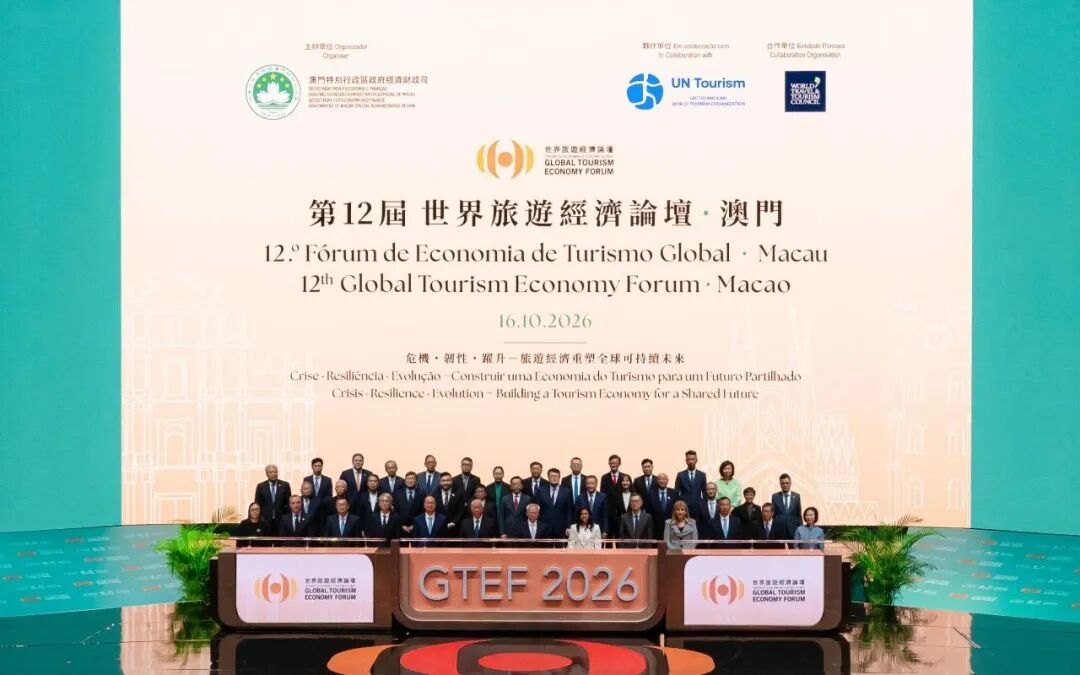
The opening scene of the 12th World Tourism Economy Forum in Macau
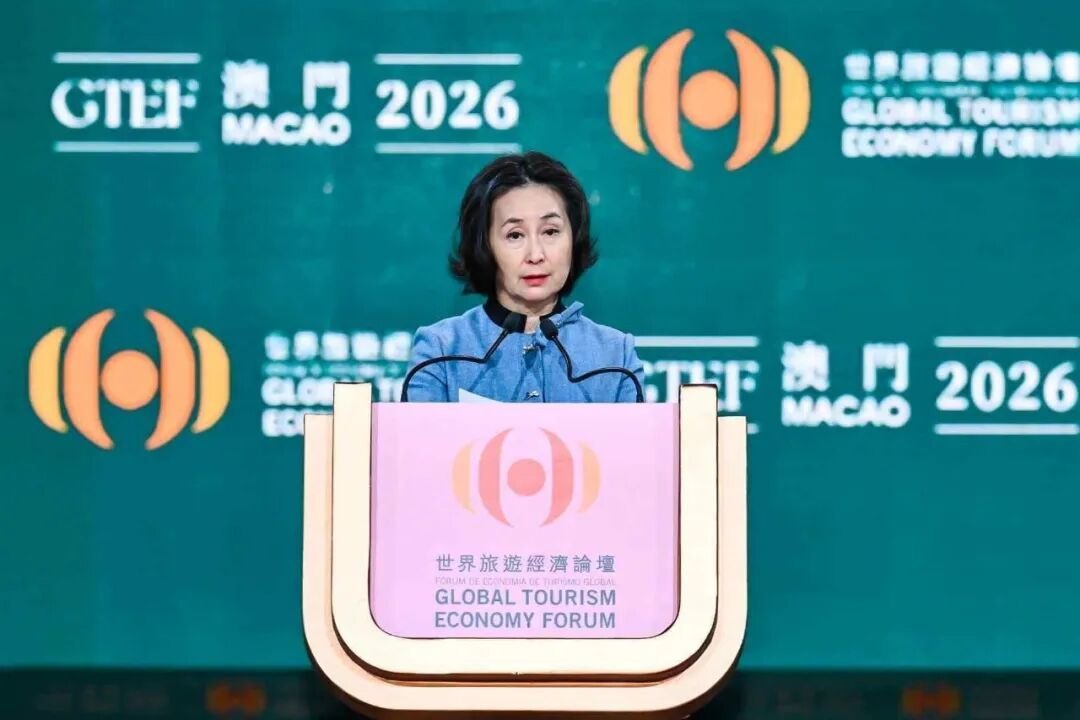
Pansy Ho gave a speech at the closing ceremony
Source: Macao Special Administrative Region Government Tourism Office