
Nanjing University Library: Preserving Millennia of Written Heritage, Young People in the Ancient Books Restoration Class
According to China News Service: When you push open the door of the ancient books library at Nanjing University's Xianlin campus, in nearly 2,000 square meters of space, about 400,000 thread-bound ancient books quietly sit on the shelves, with the oldest Song dynasty edition being almost a thousand years old.
Most of the precious documents in this collection went through a kind of 'cultural Long March' during the War of Resistance. In 1937, the Institute of Chinese Culture at Jinling University (one of the origins of Nanjing University) urgently entrusted Mr. Wu Lianyun in Wuyuan, Jiangxi, with 95 boxes containing over ten thousand volumes of rare books. Li Dan, head of the Rare Books Department at Nanjing University Library, said what touched her most was that when these books returned in 1947, 'not only were there no losses, but there were actually more'—teachers and students had been constantly rescuing scattered documents during their exile, picking up the fragments of civilization piece by piece.
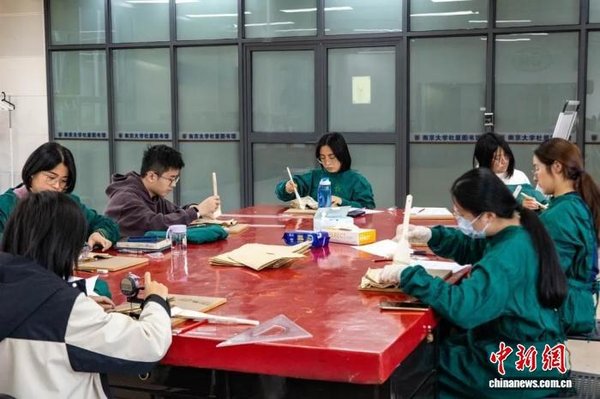
Today, this history is being revealed by more and more young people through lectures, short films, and the "Book Exile Journey" campaign. The library also offers ancient book restoration experience classes and themed exhibitions, with students covering chemistry, biology, artificial intelligence, computer science, and other majors, far exceeding initial expectations. "The cultural movement is linked to the national destiny, and the cultural context is connected to the national lineage. Only by letting young people understand what each ancient book has experienced will they truly understand the weight of 'protection.' " said Li Dan.
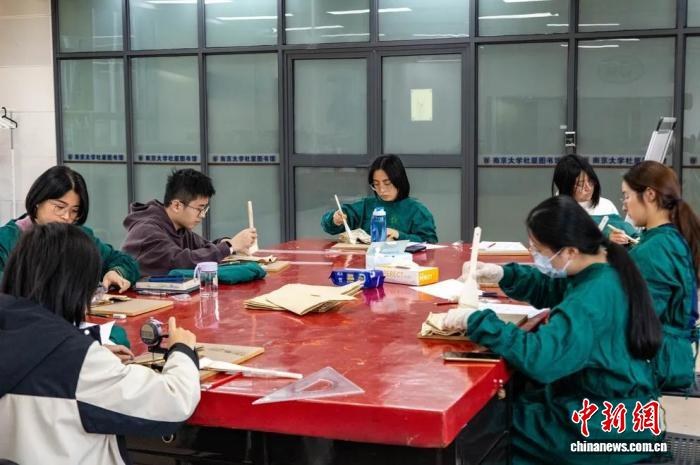
Nanjing University students take part in an ancient book restoration workshop. (File photo by Yang Yijun)
Li Hui, a PhD student in Chinese Classical Philology at the School of Literature, remembers how nervous she was the first time she tried restoring a replica teaching tool: 'When I got that wrinkled, crumpled pile of books, I felt really unsure and couldn’t imagine facing such a complicated task for the first time. But as I followed the teacher step by step, the moment I flattened all the repaired pages and folded and bound them, I felt an incredible sense of achievement.' She said that only after taking the class did she truly understand that restoring ancient books is about 'repairing the old as the old,' 'minimal intervention,' and 'reversibility'—it’s not just about fixing damage, but also about preserving the passage of time in the pages and keeping all the information that makes them historical witnesses.
An interdisciplinary background also brings new perspectives to traditional restoration. Ancient book restorer Chen Jing noticed that students majoring in chemistry focus on the aging of paper fibers and the potential side effects of restoration materials, while AI students think about digital image segmentation, virtually filling in missing text, and even trying to use machine learning to predict paper deterioration trends. “In the past, I might have only known how to get good results, but now they ask: why does this method work well? Are there any risks? Can we evaluate it quantitatively?” In recent years, Nanjing University Library has also collaborated with the polymer team from the Chemistry School to carry out experiments related to ancient book restoration.
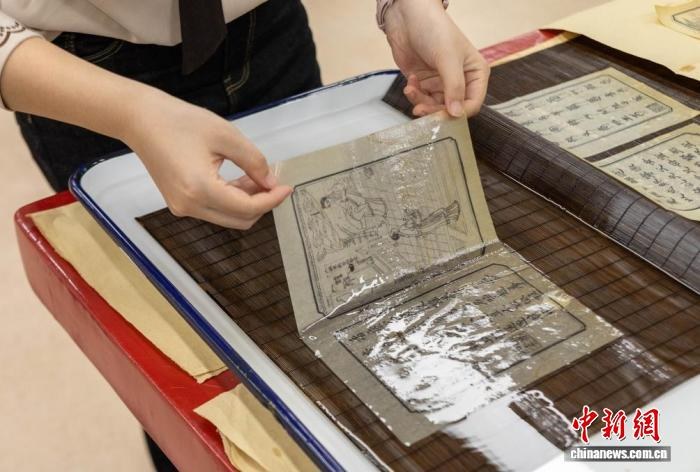
At an ancient book restoration workshop, students are using the wet lifting method to remove pages. (Stock photo by Yang Yijun)
"What restoration of ancient books requires most is a sense of reverence and patience. Every scrap of paper is precious, and every tiny fragment and detail must be preserved as it is. It's meticulous and repetitive work, and you won't see results quickly, so impatience won't help," said Chen Jing. Li Dan looks even further: a single restorer can only repair a limited number of ancient books in their lifetime, but if more young people from different fields recognize the value of ancient books and are willing to participate in their own ways, 'the power of ancient book preservation becomes endless—it's not addition, it's multiplication.'